Thursday, 20 December 2012

Happy crossbows... I mean, Christmas...!

Before I sign off the the holiday and disappear into the wilds of Somerset, I thought I'd point you at this interesting clip on Youtube:


I gather that this demonstrates the use of what could be called an Arbalest, as this seems to be what we can see in the footage. These would be what D&D would call a 'heavy crossbow', and seems to be a bit more dangerous than the D&D version. That said, there are accounts of brigandine being able to provide protection against crossbows - although what type of crossbow and at what range, I'm not sure.

See you in the New Year - providing I haven't suffered death by cider...

Wednesday, 19 December 2012

Taking breastplates too literally...


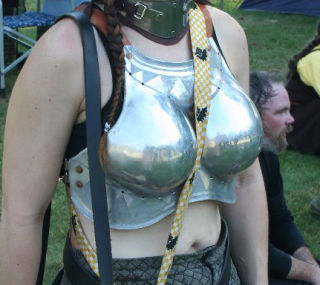
As I've said before, the way women are depicted in many fantasy RPGs is usually pretty poor. I was going to consider how this tends to revolve around the artists apparently being obsessed with showing cleavage no matter what, and that the depiction of women in armour was not immune from this. This was then going to segway into the impracticality of such designs - but someone has beaten me to it.

As that article points out, the type of armour shown in the above photo would cause problems to the wearer should she fall forwards. Even with a padded jack underneath, the amount of damage caused by blunt trauma wouldn't be at all pleasant. You also don't really want to have anything that acts as a handy channel for weapon strikes against vital organs. Traps and channels on armour, shield bosses and weapons are there to snag or interfere with the path of an attack in some way. Ideally that means that the attack is kept away from the vitals, limbs, etc. A similar principle occurs with another armoured thing - tanks. Certain parts of a tank can, if not designed correctly, act as 'shell traps' for incoming rounds. Sometimes this traps those rounds near vital areas, such as the drivers position. Not good.

The article makes note of female armour in Mass Effect 2, but I'd say that that's also barking up the wrong tree. First and foremost, it's pointlessly sexualised in a way that the man's armour is not. If the same thing was done with the man's armour - say, the inclusion of a large, protruding armoured codpiece - most people would say 'That looks ridiculous'. But for some reason this sort of silliness generally isn't pointed out when women's armour is sexualised. Secondly, it's not at all practical for someone who may need to lie prone when firing a weapon, take cover, crawl, etc (and the same rule would apply to the armoured codpiece). Take an illustration from modern body armour - here, for example. Note that there's no mention of women needing an armour that both seperates and supports. It just needs changing in a few key areas to better match the anatomical differences. The same factors would apply to women wearing armour in a fantasy RPG setting. 

What does this mean for an artist wishing to avoid the common cliches? Well, the simple fact of the matter is that there's pretty much little difference in the way that men and women look whilst wearing armour. This is especially so with plate armour, and if a full-face helmet is worn. However, that doesn't mean that there aren't subtle visual cues. If we consider the fact that, even in a fantasy RPG setting, men and women fighters would have had to have trained with their armour since an early age we could perhaps take our cues from modern imagery. One possible consideration could be male and female athletes from the same sports. There are similarities in their body shapes to a certain extent (depending on the sport), but there are also differences. At the end of the day this boils down to a couple of factors. One: an understanding of anatomy (hint: breasts aren't solid masses). Two: observation of how things can look in real life and drawing on that for inspiration. Three: developing an understanding of what's being observed (for example, how is the armour constructed? Is it part of a layered suit?). Whilst I might hesitate to say that many RPG artists lack such skills, it does seem that they are willfully abandoning them in order to follow a more hackneyed approach. That doesn't ultimately send out the right sort of signals, both about the outlook of the artist nor whatever RPG is using the artwork.

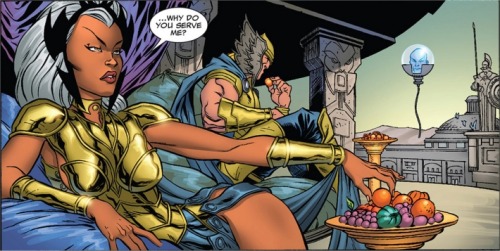
One other factor that seems to feed into this is the way women are portrayed in other fantasy art. I'd say the main culprit is comic art, of the super hero variety. Super heroines tend to wear 'boob socks', and it seems that the fashion has been translated into armour somewhere along the way. Maybe with a nod towards being slightly less silly, but silly nontheless.

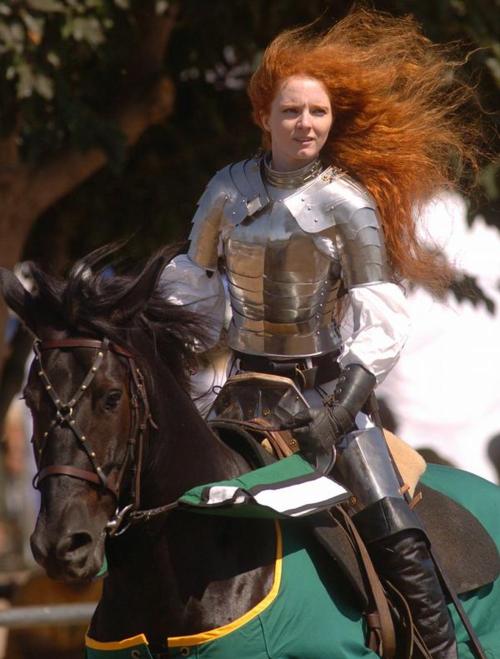
But it's not all doom and gloom. We don't have to be stuck with chainmail bikinis and those breastcup cuirasses. There are depictions out there of women in armour that aren't rubbish. For example...

The above image is of Theresa Wendland, and comes from here
A nice example from LARPing...

Sourced from here
Some lamellar armour...

Sourced from here

Some more plate, this time worn by Virginia Hankins...

Sourced from here

And if you want something with more of an RPG flavour, there's this...

Sourced from here

And here's a more naturalistic pose (okay, it's not armour but there is a weapon involved)...

I wish I knew where this originally came from. I dug it out from Tumblr somewhere and haven't been able to find it via Tin Eye...

See? All pretty good! And not a chainmail bikini in sight. Okay, so perhaps some of the above are a little stylised. What if we consider how a woman might look when engaged in combat with a sword or other weapon? Here's one interesting video, featuring Theresa Wendland:


Their training weapons are a bit heavier than actual fighting versions, but you get the idea. Note the stances, attacks and parries used in the above clip - all apparently sourced from actual fighting treatises from the Medieval period. And a tad different from the sort of fighting stances one sees women posed into for RPGs. Here's something a little more florid, although equally of interest and featuring Virginia Hankins:

Hopefully all of the above demonstrates that we don't have to keep treading the well-worn Dreaded Path of Ye Olde Fantasy Clichés. Artists can chose not to go down it, and hopefully one day more of them will. Women don't have to be dressed up in silly 'armour' and costumes for RPG settings. It just takes a bit of time and effort, and less of a closeted mindview as to how women are depicted.

Friday, 14 December 2012

On the Physiology of... the Otyugh - Part Six.

Moving around

As I've previously mused on whether the Otyugh is more like some sort of slug, a question arises as to how it moves around. Originally I imagined that it had a slug or snail-like 'foot' - a sort of large pad which skimmed along a film of mucus. However, I wasn't sure that this was veering away too slightly from the whole idea of it being an animal which is fairly tough all over.

As it's a creature that needs to burrow into its food in some way, one idea was to make its underside flat but ridged so that it has some grip. That dovetailed into my previous ideas about the Otyugh being a mixture of rubbery hide and harder, mineral-like features. All of this combined into this scribble:

This shows a cross-section of one area of the body.

This shows those ridges, but also the teeth-like 'nails' it relies on for grip and perhaps also extra burrowing power. If we zoom in a bit, we can see how this might look in greater detail:


One idea driving this is that the underside is like some sort of toothed conveyor belt. With that in mind, a question arises as to how it might look when moving - I guess it could either move solely by the underside rippling along, or instead perhaps the whole body arches and rolls along in a caterpillar-like way. Here's a scribble showing how the muscles controlling this under the hide could look:

The idea is that they're ropey tendons attached to the main mass of the spine plates.

My various posts on the Otyugh will hopefully combine soon into a more detailed picture. Watch this space!

Monday, 3 December 2012

Hellfrost Land of Fire Kickstarter

This Triple Ace Games' Kickstarter project finishes soon. They're pretty close to hitting their target funding level, so go take a look and see if it's your cup of tea:

More info...

Tuesday, 27 November 2012

Pole axes, falchions, and other stuff...

When I first started playing D&D, I had no idea what a Bec de Corbin was, nor something as exotic sounding as a Bohemian Ear Spoon. The name alone was enough to conjure all sorts of mental images. Although recent versions of D&D seem to forgo the roots of the game with regard to the medieval influences, some of you may still want to include the variety of weapons 1e etc included. 

Luckily, there are various ways of finding out what those weapons looked like and what they did. You could, for example, get your hands on a copy of G.C. Stone's A Glossary of the Construction, Decoration and Use of Arms and Armor in All Countries and in All Times, Together With Some Closely Related Subjects. I advise getting a used copy, as they're cheaper (mine was less than 20 quid and seems to be an ex-library copy from Canada). It's a weighty illustrated tome that describes a variety of weapons that could be used in D&D or a similar fantasy setting. You just have to try and ignore the fact that it was written quite some time ago and still lists some cultures as being 'savages'. I kid you not.

If, however, you want a quick overview you could always try YouTube. For starters, there's this:


Or this:


Okay, the presenter is a bit creepy but neverthless it's interesting to see a reconstruction of these items and, to a certain extent, how they were used. 

If you don't mind the somewhat flippant approach to the subject matter, there's this:


Parts 2 and 3 can be found here and here. This gives a good basic overview of the sort of weapons one could use in earlier versions of D&D.

One interesting factor about some of these weapons is that they have more than one use. The pole axe has, for example, three different parts that can attack in different ways and these could be handy for different situations. This is isn't really covered by the 1e D&D weapon rules aside from what happens when being charged by an opponent. I guess that one could, as is the case with some monster attacks, divide up the potential damage into different types.

From an artistic point of view, such footage can come in handy when trying to visualise how someone might look when putting such weapons to use. There's also the fact that most of the people involved in these videos are wearing armour etc similar to the sort of kit adventurers would in a fantasy RPG setting (although perhaps not all that plate...). It seems that quite a bit of fantasy art owes more to LARPing or Renaissance festivals - which isn't a good thing.

Anyway, hopefully the above stuff shows that you don't have to resort to silly giant two-headed axes, massive manga-esque swords etc in order to have some interesting weapons to hand in D&D and other similar RPGs. As I've said before, history has usually already provided a tried and tested precedent that you can borrow from - and a fair few of these are somewhat exotic.

Right, I'm off to the shops. Now, where did I put that Earspoon...?

Friday, 23 November 2012

Japan's ninjas heading for extinction

An interesting article appeared today on the BBC website about the demise of the ninja. It seems that once the last generation of actual ninjas dies there will be no more of them. I hope that there is going to be some sort of effort to set down information about what they did for the historical record.

I also imagine that, once this last generation has gone, the way ninjas are portrayed will probably get even sillier than has been the case over the years. As a subject, they've had a rough handling from film and TV - not to mention RPGs. Even basic ideas about what they look like have been disposed of, for various reasons. For example, this is what a ninja actually looks like:


And this is an example of how a modern RPG tries to do things:

The above image comes from a Gaming As Women article.
Note the difference between reality and a badly researched image. Poor ninja. And in the above case, poor female ninja. I also imagine you could hear her approaching a miles off with all that kit clunking about.

Why is this a big deal? Well, even in a fantasy setting, what enriches any given subject is how much it can tap into what's already real. I mean, what's the point of doing anything about ninjas if it's not taking a lot of cues from the real ones? Add to that the fact that, if you're going to borrow ideas from the history of any given culture, are you doing yourself any favours by trying to rewrite that for your own ends? Too many people have done a bad job of it - do you really want to add to that? If you're going to borrow, do a good job of it. Likely as not, the realities of how your chosen subject matter has developed during it's existence is going to a rich source of ideas and inspirations. Chucking all of that out of the window to make some half-assed presumptions is probably not a good idea.

If you don't believe me, see how bad things can get: MST3K goes toe-to-toe with 'Master Ninja'...


Tuesday, 20 November 2012

All hail Escher Girls...!


On a day when some silly people couldn't decide whether they're still scared of women or not, I thought I'd draw attention to the excellent Escher Girls blog

Although it focuses more on artwork from comics, anime and digital RPGs, those providing artwork for paper 'n' dice RPGs should take note. As I pointed out in one of my previous blog posts, the depiction of women in RPGs is usually awful. Escher Girls does a great job of showing the same sort of silliness going on in other types fantasy artwork. For me, this works well on several levels:

- It shows that there seems to be little interest in actually depicting women in any sort of realistic manner, either thematically or physically.

- It shows how bad a lot of artwork is. Many artists either have no idea how to actually draw, and/or ignore anatomy in order to create some very weird poses. These are also sexualised, for some reason or other. Okay they can't draw men either, but they don't seem to try and make them fit into such poses. I suspect that what's actually going on is that artists are copying other artists, rather than learning how to to draw. This may explain why modern comics seem to be distorting things even more than older comics. Or, it may be that 'how to' guides by established artists also have  a poor attitude towards the subject.

- It's thought-provokingly funny. By deconstructing the various images, it shows how badly done most of them are and at the same time makes it very clear how far such imagery goes in it's crassness. This works especially well when the the characters are changed to being men. It's also interesting to see how changes can be made in order to make the images actually work.

Mixed in with all of this are a variety of posts which consider what's going on in the imagery and what it suggests about the various attitudes and assumptions involved. As with the Gaming As Women blog, it does a very good job at holding these things up for consideration. 

The world of RPG art is still pretty much making the same mistakes as many comics, anime, etc. It's obviously not because it's trying to treat the subject matter with any sort of balanced consideration. Or maybe it's just laziness. Either way, it should be easy enough to fix if enough time and consideration is given to the subject. It would also help on a technical level. Artists should be familiar with anatomy. They should have been to life drawing classes - or should plan on going to some. Don't simply copy what others have drawn. If instead you can only copy from photos, find some good ones. Even somewhere such as Flickr has enough stuff to pick from that doesn't rely on clichés.

Monday, 19 November 2012

Turn to 400 - The Fighting Fantasy documentary film

As it's just passed the halfway mark, I thought I'd take the opportunity to plug  this Kickstarter project again:


If, like me, you grew up with the FF books and would like to see this worthwhile project come to fruition, please chuck some money at them! More info can be found at the project's Kickstarter page...

Friday, 16 November 2012

Today's eye candy... artwork by Russ Nicholson


I've been a big fan of Russ' work since I first saw it in 'The Warlock of Firetop Mountain' but I only discovered his blog today. It's full of pieces by him that I've not seen before, and has many interesting insights about how his work develops.

The thing I enjoy the most about Russ' work is his use of line. The balance and the contrast of his marks and how they work as an overall whole is very interesting. They seem very fluid but at the same time are very accurate and well placed. Every mark is there for a purpose and not just something to fill in open space.

Very much worth a look!

The Gallery: Russ Nicholson

Wednesday, 14 November 2012

Can RPGs be too clichéd (or worse)...?

A pet peeve...

One thing that's always bugged me about RPGs - especially those with a fantasy setting - is that they can tend to be chock full o' clichés. Not so much in how they read as a system or a world as such, but how they present themselves to potential players (and everybody else, for that matter). I noticed this as a new player back in the 80s, and it still seems to be a thorn in my side today. It doesn't seem to be as much of a 'problem' for, say, sci-fi or horror RPGs. Okay, this may be more about artwork than anything else, but art can sometimes be it's own strong theme within any given RPG. We can't deny that it's used in RPGs as a way to help frame the overall vibe of the game - but it seems that some clichés just won't go away. So let's consider a few of them...

Women

Let's face it, women are usually portrayed pretty bloody poorly in a lot of fantasy RPG art. This isn't just the case in '70s era D&D, where the social mores of the time were a little... different (not that that excuses it). It's still the case nowadays. WotC and Paizo are both guilty of this with D&D and Pathfinder. Much as they may try and wriggle out of it (i.e. see this interesting post over at the excellent Gaming As Women blog), they still tend to churn out the same old crap. Or variations on it. It's not exactly original nor is it something that sends out any sort of positive signals. Do I blame the artists? Well, yes and no. Maybe they just like to draw scantily-clad women. Or maybe their art directors say they should draw them that way. Either way, it's lazy.

The interesting thing is that the game world of D&D etc doesn't really mention anything about the role that women have in them. Okay, maybe these can be inferred in some way, but that's perhaps down to who's playing the game. Things seem to be inherently less polarised than real-world modern societies. But the way RPG art handles things tends to ignore this and instead plumps for tried and tested fantasy portrayals. To my mind this actually makes things less interesting. It seems that such portrayals have missed the plot.

Equipment

What do I mean by equipment? Well, I mean clothing, weapons, armour and general kit. There seems to be a tendency in modern versions of fantasy RPGs - and, again, D&D and Pathfinder being obvious examples - to seem to want to go down the World of Warcraft/Japanese digital RPGs route. That is, equipment is portrayed in a rather silly way, and some bits tend to get ignored completely. So the overall picture of any given character type focuses on certain things at the expense of others.

Let's take armour and weapons, for instance. Originally, D&D took it's influences for such things from the Medieval period, and with good reason. The way armour and weapons evolved up to and throughout that period fits the setting well, whilst at the same time suggests a plethora of styles and designs. However, this tends to get ignored. Your average depiction of a fighter-class person tends to owe more influences to Frank Frazetta than anything else. Or, as I mentioned above, World of Warcraft in mordern versions of some fantasy RPGs. Thus we see depictions of madly impractical armour and weapons - huge swords and double-headed axes, armour that you can probably only stand up in because of the spikes, huge curved sections, etc. Again, who's to blame? Well, I'd say artists. It seems that people haven't done some actual - even basic - research. Perhaps all that actual history just isn't enough. This is a real shame because if they stopped looking at how other lazy artists have done the same thing (a copy of a copy of a copy...), they'd see that armour and weapons from history can be interestingly eccentric. To give one example: many moons ago I created some artwork for the 'Ultima Thule' sourcebook for Ars Magica. I dug into my research and looked at how Viking and Scandinavian clothing, weapons, etc should look. This fed directly into my illustrations. All of that was then undone by the cover artwork, which decided instead to resort to clichés. The Viking even has a horned helmet. Oh well. Anyway - have a look at this page on medieval weapons and armour. Lots of odd designs there, but all evolved to be that way from practical use. This doesn't have to mean that it's boring. Similarly, if we have a look at the historical artwork of an artist like Angus McBride we can see that there's a variety of interesting shapes, designs and colours.

As for other bits of kit, things tend to get worse. Practicality is out the window. If a woman is wearing anything, it tends to be scanty in some way. If it's a magic user or magical character class, they wear some sort of elaborate cassock - unless they're a female magic user, in which case they wear something scanty but long-flowing (i.e. see the Pathfinder core rulebook cover). You rarely see 'in-action' scenes with the characters lugging about the stuff we all know they should have: rope, baggage, lighting, bedding rolls, etc. No-one seems to be wearing anything that would help you in a cold, dirty, inhospitable dungeon environment. Why can't someone depict a magic user in a more practical garb? A cassock-like thing doesn't seem all that sensible to me. Imagine the draughts, for starters.

To sum up (for now)...

Okay, this may seem like a bit of a rant. Perhaps I'm taking things too literally. But why should the depictions in fantasy RPGs be doomed to stick to clichés? It seems a bit half-arsed. Things don't seem to have changed all that much since the '80s. It's all a little too staid and predictable. Whilst I'm not saying that fantasy RPGs have to take their influences from medieval stuff, it might actually help drive things along more original paths. Failing that, is it perhaps too much to ask that something more imaginative gets added to the mix?

That's it for now - until I can write about some other stuff along similar lines. Please feel free to pick holes, disagree, etc...