Saturday, 25 June 2022

Spiders...! (Part One)

The first in a series about spiders...

WHIP SPIDERS


Whip Spider (Lesser)

FREQUENCY: Uncommon
 

NO. APPEARING: 1-8
 

ARMOR CLASS: 4

MOVE: 8"

HIT DICE: 4 +4

% IN LAIR: 30%

TREASURE TYPE: C

NO. OF ATTACKS: 3

DAMAGE/ATTACK: 1-12, 1-12, 1-12

SPECIAL ATTACKS: Paralyzation

SPECIAL DEFENSES: Nil

MAGIC RESISTANCE: Standard

INTELLIGENCE: Animal

ALIGNMENT: Neutral

SIZE: L (12' long, excluding forelegs)

PSIONIC ABILITY: Nil

       Attack/Defense Modes: Nil

Whip spiders are large mountain-dwelling creatures whose forelegs are some 20' long and very flexible. They use these to capture prey across passes and crevasses as well as for climbing steep rock faces. They see equally well in daylight or in complete darkness and sometimes hang by their rearmost legs from cave ceilings to wait for passing prey. Their colouration and the rough surface of their body makes them particularly difficult to see and this, combined with the long reach of their forelegs, means that they surprise on a roll of 1-3 (on a 6-sided die). The tip of each foreleg ends in a small claw that can inflict 1-12 points of damage, and those struck must save vs paralyzation or become completely immobilised. A victim may then be dragged towards the spider's fangs and drained of 1-12 hit points per turn. When not in use, the forelegs loop back over the creature's body.

These creatures do not spin webs, choosing instead to make lairs in deep caves and sometimes within dungeons and other subterranean places. If encountered in their lair, there is a 50% chance that 2-12 hatchlings will also be present. These have 1HD +4 but do not possess a paralysing attack from their 5' long forelegs. Their claw and bite attacks inflict 1-4 points of damage. 


Whip Spider (Greater)

FREQUENCY: Rare
 

NO. APPEARING: 1
 

ARMOR CLASS: 2

MOVE: 6"

HIT DICE: 6

% IN LAIR: 75%

TREASURE TYPE: C

NO. OF ATTACKS: 7

DAMAGE/ATTACK: 2-20 (per foreleg), 3-18

SPECIAL ATTACKS: Paralyzation

SPECIAL DEFENSES: Nil

MAGIC RESISTANCE: Standard

INTELLIGENCE: Animal

ALIGNMENT: Neutral

SIZE: L (20' long, excluding forelegs)

PSIONIC ABILITY: Nil

       Attack/Defense Modes: Nil

This rarer form of Whip Spider often chooses to reside within gullies, pits and similar locations. Each 30' long foreleg is made up of three long sections that can act independently, two of which are kept outside the creature's lair. In this manner they can detect the approach of prey and are particularly difficult to see, thus surprising on a roll of 1-4 (on a 6-sided die). When attacking, the spider will attempt to paralyze victims and those failing a saving throw will be dragged into its lair, where its fangs will drain 3-18 points of damage per turn. Each foreleg also inflicts 2-20 points of damage with every successful attack.

There is a 25% chance that the lair will also contain 1-3 Lesser Whip Spiders, as well as 1-6 2HD hatchlings. These possess four 10' long forelegs each capable of inflicting 1-8 points of damage, as well as possessing the ability to paralyze their victim. Their bite also inflicts 1-8 points of damage.   

Note: For both varieties of Whip Spider, any treasure will be found within the remains of previous victims. Also, the Dungeon Master may rule that an encounter with a Lesser or Greater Whip Spider might include one or more individuals in transit and carrying hatchlings upon their backs. However, such an encounter will provide no treasure.

Saturday, 18 June 2022

Flame Snail...

It seems that not everyone is a fan of 1E AD&D's Fiend Folio. I kind of understand this, as initially upon first reading through it I wasn't sure how and why I could use the various monsters when so many have a frequency of Very Rare. Admittedly a fair few of the monsters are pretty left-field but, to be honest, that's what I find appealing about both the Fiend Folio and Monster Manual in general. I mean, why should any of the monsters in D&D make sense? Why can't there be Flumpfs?

Anyway, one of my favourite monsters from the Fiend Folio is the Flail Snail. To me, it ticks various boxes: it's a typically odd D&D monster, it has some interesting capabilities, and it just generally fits into the world of D&D in the sense that it seems to be something that's part-magical, part-mundane.

With that in mind, I thought I'd design a few other creatures inspired by it, the first being the...

FLAME SNAIL

FREQUENCY: Very rare
 

NO. APPEARING: 1
 

ARMOR CLASS: 4

MOVE: 4"

HIT DICE: 4-6

% IN LAIR: 0%

TREASURE TYPE: Nil

NO. OF ATTACKS: 1 per tentacle

DAMAGE/ATTACK: See below

SPECIAL ATTACKS: See below

SPECIAL DEFENSES: Nil

MAGIC RESISTANCE: Standard

INTELLIGENCE: Low

ALIGNMENT: Neutral

SIZE: L

PSIONIC ABILITY: Nil

       Attack/Defense Modes: Nil

Flame Snails appear to be a smaller (6' tall) relative of the Flail Snail but, instead of clubs, each of its tentacles ends in a fiery bulb. When attacking, each of these can emit a globule of burning matter out to a range of 20' which inflicts 2-12 points of damage for 3 rounds, unless extinguished. At close range, these can instead strike a target and inflict 2-12 points of damage. 6HD Flame Snails have a single tentacle that can emit a Fireball, the snail casting as a third-level Magic User. It has one tentacle for every hit die that it possesses and each tentacle has its own hit points.

Should all of these tentacles be destroyed, the body will be quickly withdrawn into the shell and the snail will die in 1-4 turns. Upon death, the shell explodes violently, spreading burning matter and fragments over an area some 50' in diameter. Any creature within this area will receive 3-18 points of damage. There is a 50% chance that their clothing, skin, hair, fur, etc will continue to burn for 3 turns (unless extinguished by normal means) inflicting a further 1-6 points of damage per round.

The snail casts a faint glow and emits great heat out to 2' from it's body. This heat will ignite any flammable material it moves through or over and will temporarily blind any creatures possessing infravision unless they distance themselves from it by at least 50'. Flame Snails are not known for their speed, but should any victim fall beneath it they will receive 1-8 points of damage per round by being crushed by the snail's weight and burnt by the heat it generates. Flame-based attacks, magical or mundane, will have no effect upon it and will simply allow the snail to regain 1 HD of hit points per attack, should it have lost any previously. Cold-based attacks inflict double damage.

Intact shells are very rare and usually only found when a Flame Snail has died naturally. The shell weighs 150 pounds (1500 gold pieces weight) and can be fashioned into items that are completely resistant to heat and flames, magical or mundane. A complete shell is worth 7-8000 gold pieces, although artificers who can work the shell might prove difficult to find.

Flame Snails are a vivid orange in colour streaked with bright yellow and its tentacles are blackish-red. Its shell is yellow-white and semi-opaque. Strange flames and burning shapes seem to roil within it. 

Saturday, 4 June 2022

Cave Elephant...


Inspired by elephants who occasionally go underground...

CAVE ELEPHANT


FREQUENCY: Uncommon

NO. APPEARING: 3-30
 

ARMOR CLASS: 3 (or 5 - see below)

MOVE: 12"

HIT DICE: 9

% IN LAIR: 20%

TREASURE TYPE: Z

NO. OF ATTACKS: 5

DAMAGE/ATTACK: 2-12, 2-12, 1-10, 1-10, 1-8 

SPECIAL ATTACKS: Paralyzation, confusion

SPECIAL DEFENSES: None

MAGIC RESISTANCE: Standard

INTELLIGENCE: Average

ALIGNMENT: Neutral

SIZE: L (6' tall, 8' long)

PSIONIC ABILITY: Nil

       Attack/Defense Modes: Nil 
 

These subterranean creatures have adapted an underground life and have also acquired various means to protect themselves. To dwarves and gnomes they are generally known as 'Iron Eaters'. In fact, Cave Elephants will occasionally co-operate with either in order to find veins of precious metals and stones, although all attempts to domesticate the elephants have ended disastrously, as they are ordinarily bad-tempered.
 
Cave Elephants will always be encountered in underground places and never venture above ground, being completely blind in natural sunlight. Powerful light sources (such as those created by magic) will confuse them for 1d3 turns. They normally use infravision and a bat-like sonar to find their way in complete darkness, although they can also see normally in low light environments. Their elongated bodies, powerful claws and forearms allow them to navigate confined spaces and also dig through solid stone at 1" per turn and through loam at four times that rate. Powerful teeth enable them to consume rocks, and it is thought that they gain some sustenance from the consumption of iron-bearing rocks. They are adept at locating these and those containing other metals, including precious varieties, as well as rocks bearing precious stones. The elephants seem to possess an unusual interest in gold, electrum and precious stones in any form and thus may seek to acquire them from parties of adventurers or from caches, treasuries, etc within dungeons.
 
They will usually avoid contact with miners and adventuring parties unless they believe that they can gain from it in some way, either by co-operating or by the use of force. When attacking, steely talons on each forelimb inflict 2-12 points of damage or they can lash out with their trunk to inflict 1-10 points of damage. The tip of the trunk and the tail are both capable of delivering a sting that will incapacitate a victim unless they save vs. paralysation. Trampling a victim with their feet inflicts 1-10 points of damage. The trunk can also grab and crush dwarf-size or smaller victims, inflicting 1-8 points of damage. Lastly, eye-like objects situated below the creature's eyes will cause confusion for 1-6 melee rounds to any intelligent creature who looks at them squarely and fails to save vs magic. They are immune to fire and cold attacks, magical or otherwise.
 
They will readily attack goblins, orcs and kobolds unless very outnumbered, and will consume any that they kill. Similarly, anyone killed during combat with them will be eaten or taken away to be consumed at some later time, as the elephants are not averse to carrion. Any armour, weapons, possessions, etc will eaten along with the flesh and bones. Only treasure, in the form of coins, gems or items decorated with such, will be spared and taken to the elephants lair. Magical items will only be kept if they are decorated with precious metals or gems.
 
Cave Elephant lairs have a 50% chance of containing a single 4HD young elephant, as well as the treasure type listed above. Encountering more than 10 Cave Elephants will indicate that a larger lair has been located. 1-4 of these individuals will be 4 HD young. If 20 or more Cave Elephants are encountered, the lair will also contain a single 10' tall 12 HD individual whose attacks deliver 3-18, 3-18, 2-12, 2-12, 1-10 respectively. There will also be 1-10 4HD young.
 
They have their own language with which they can communicate over great distances, although this cannot normally be heard by other creatures. They can also speak Dwarven and Gnomish, albeit haltingly and with a limited vocabulary. 12 HD individuals may also have a limited grasp of Common. They have superb memories and will recognise anyone they have met previously and can recall past events with ease. Similarly, their hearing is excellent and thus they are only surprised on a roll of 1.
 
Dwarves and gnomes generally have taboos about using the hide, etc of dead Cave Elephants, given their respect for them. Goblins, orcs and kobolds however will readily attempt to use the hide to reinforce their armour, despite the hide being extremely resistant to working. As such, it is usually only worn by leaders and chieftains and reduces their AC by two points (i.e an armour with AC6 becomes AC4 when reinforced with the hide). The elephant's claws and teeth are repurposed as pickaxes and other mining tools.
 
Description: Cave Elephants are various shades of grey or greyish-yellow in colour, appearing smoother and less wrinkled than their surface dwelling cousins. Their heads, shoulders, forearms and trunk are dotted with clusters of darker patches of stone-like concretions and these parts have AC3. The rearmost part of the animal (an an area midway along the spine and ending with the rear legs and tail) is generally devoid of such patches and is AC5. Their claws are blueish-black and resemble tempered steel. The elephant's undersides and the tips of the trunk and tail are pinkish grey. It is thought that they live for 350-500 years and there are rumours that their graveyards, hidden deep underground, contain large hordes of treasure.  
 

Saturday, 28 May 2022

Dead Man's Lantern

This week's monster uses infravision against those who have such ability...

DEAD MAN'S LANTERN


FREQUENCY: Uncommon

NO. APPEARING: 1
 

ARMOR CLASS: 3

MOVE: 12"

HIT DICE: 4

% IN LAIR: Nil

TREASURE TYPE: Nil

NO. OF ATTACKS: 6 (2 talons, 2-4 tendrils)

DAMAGE/ATTACK: 2-12

SPECIAL ATTACKS: See below

SPECIAL DEFENSES: Nil

MAGIC RESISTANCE: Standard

INTELLIGENCE: Animal

ALIGNMENT: Neutral

SIZE: L (30' long)

PSIONIC ABILITY: Nil

       Attack/Defense Modes: Nil 
 

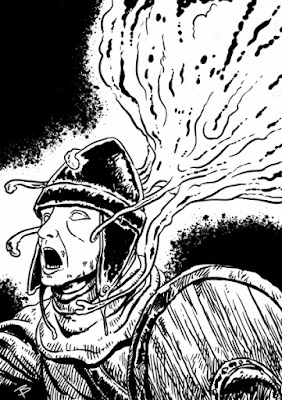
The Dead Man's Lantern spends the majority of its life in the roofs of caves and similar subterranean places but much prefers dungeon environments. It resembles a long thin centipede with numerous pairs of small claws which allow it to hold fast onto any wall, floor or ceiling. Small eyes are dotted along its spine with a larger cluster at the centre of its body, both ends of which end in a long tapering section tipped with a venomous talon. Its carapace is so textured as to appear to be stone or similar surface and is almost impossible to detect. The creature is also completely invisible to those creatures that possess infravision.    

However, when seeking prey it uses both normal sight and infravision to lure victims to a space within the striking range of its talons. It can detect creatures up to 200' away and when they pass through the outer edge of this limit it excretes long tendrils of a sticky substance ending in a luminescent bulb that extends a ragged sheet-like form. It then moves these from side to side and slowly advances towards its prey. To those creatures with normal sight, the bulbs resemble swinging lanterns, but to those possessing infravision, both the bulbs and the sheets resemble a party with lanterns moving in single file. 

The creature is careful not to engage large groups (i.e. with more than 5 members) and will attack once its intended victims are within striking distance of one of its talons, at which point it switches off the light and infravision effects cast by its tendrils. Each talon inflicts 2-12 points of damage and, if a poison saving throw fails, the victim dies immediately. It will also attack with its tendrils in an effort to stun opponents, who must save versus paralyzation.

These creatures prefer to consume dwarves, goblins and other smaller underground dwellers, but will readily attack parties made up of various races if their numbers are within the aforementioned limit. Victims of their venom will dissolve in 2-10 rounds and the remains will be consumed by a proboscis within each talon.


Saturday, 22 January 2022

Jellies..! Part Six

MIND JELLY


FREQUENCY: Very rare
 

NO. APPEARING: 1
 

ARMOR CLASS: 2

MOVE: 8"

HIT DICE: 8 +4

% IN LAIR: Nil

TREASURE TYPE: Nil

NO. OF ATTACKS: See below

DAMAGE/ATTACK: See blow

SPECIAL ATTACKS: See below

SPECIAL DEFENSES: See below

MAGIC RESISTANCE: 85%

INTELLIGENCE: Very

ALIGNMENT: Neutral Evil

SIZE: S (3 feet wide)

PSIONIC ABILITY: Nil

       Attack/Defense Modes: Nil


Wild rumour and folklore suggests that these creatures are the minds of long dead evil magicians, or are the result of some frightful experiment gone wrong. Mind Jellies visit the Prime Material Plane in order to feed, but their point of origin is unknown and such journeys are thankfully rare.

Although they are happy to devour the minds of any sentient creatures they hunt, they are particularly drawn to Magic Users and will seek them out when they encounter adventuring parties. The jelly will send forth 2-12 feelers up to 10 feet in length towards an individual it has decided to attack, and those touched by them must save vs paralyzation. A victim will then be drained of Intelligence at the rate of 1d3 points per round until that ability reaches zero or the Jelly is killed or driven away (by losing more than half of its hit points). If a Magic User is attacked, that individual will also be drained of one spell per round (highest level first).

Normally the Mind Jelly only makes a single attack in order to feed, but will defend itself with two other sets of tendrils if it meets stiff resistance. In this case, these tendrils will inflict 3-18 points of damage but while doing so it can only drain Intelligence at the rate of 1 point per round. Individual tendrils have only 5 hit points but the Jelly can grow 1-6 replacements every round. The creature can only be harmed by magical weapons of +2 or greater and is also quite able to resist other magical attacks. If it loses more than 75% of its hit points, it will become invisible and flee from the Prime Material Plane. However, it is able to etherially track and pursue a victim, sometimes attacking many years later when they have recovered from their wounds (they regenerate 2-20 hit points per year).

Mind Jellies are a misshapen sphere trailing a collection of tendrils, and it floats above the ground at a height of four feet. They are unable to pass under doors etc like other forms of jelly and are usually invisible (surprise on 1-3) unless ready to attack, at which point they radiate an eerie blue light. They speak the language of most creatures, and may be bargained with if convinced that a more suitable victim can be found elsewhere. Mind Jellies have long memories and are spiteful, and will return to the Prime Material Plane to seek revenge on those who have harmed them.

Saturday, 14 November 2020

Jellies...! Part Five


Time to get back in the blogging saddle - again...

FEVER JELLY


FREQUENCY: Very rare
 

NO. APPEARING: 1-3
 

ARMOR CLASS: 4

MOVE: 8"

HIT DICE: 5

% IN LAIR: Nil

TREASURE TYPE: Nil

NO. OF ATTACKS: See below

DAMAGE/ATTACK: 1-6

SPECIAL ATTACKS: See below

SPECIAL DEFENSES: See below

MAGIC RESISTANCE: Standard

INTELLIGENCE: Non-

ALIGNMENT: Neutral

SIZE: S (3 feet wide)

PSIONIC ABILITY: Nil

       Attack/Defense Modes: Nil
 

Fever jellies are usually found in sewers and other noisome places, and are thought to be the source of various illnesses and diseases in towns and cities. Such is their preference for living in ordure and filth that there is a chance (1-2 on 1d6) that they will be found in company with 1-2 otyughs, or 2-20 giant rats.

These creatures are large spherical blobs of rotting and decaying matter, coalesced into a form made up of numerous sickening shades of brown, green and yellow. Various mushroom-shaped nodules grow randomly from the main body and are used for both locomotion and attack. Although usually content enough with consuming whatever matter falls into the sewers from above, they are keen to feast upon living prey. They will actively seek out adventuring parties once they become aware of their presence, especially if heat sources such as torches are being used.

Fever jellies attack by rapidly rolling at their opponent and striking out with a single nodule. A successful attack not only inflicts 1-6 points of damage but also acts as Cause Disease, as cast by a 3rd level magic-user. Any victim failing a Saving Throw will then succumb to a terrible malady (as described in the Players' Handbook).
 
The rubbery and resilient nature of these jellies means that only edged weapons can affect them, and their covering of slime renders them immune to fire-based attacks. However, other heat-based attacks have their normal effect against these creatures, as do lightning bolts.

Saturday, 29 February 2020

Jellies...! Part 4

And still more jelly! This one includes stats for Old School Essentials

ICE JELLY
  

FREQUENCY: Very rare
 

NO. APPEARING: 1
 

ARMOR CLASS: 8

MOVE: 6"

HIT DICE: 5

% IN LAIR: Nil

TREASURE TYPE: Nil

NO. OF ATTACKS: See below

DAMAGE/ATTACK: 2-12

SPECIAL ATTACKS: See below

SPECIAL DEFENSES: See below

MAGIC RESISTANCE: Standard

INTELLIGENCE: Non-

ALIGNMENT: Neutral

SIZE: M (4 feet wide)

PSIONIC ABILITY: Nil

       Attack/Defense Modes: Nil
 

At first glance, ice jellies appear to be nothing more than an uneven patch of frozen water on a floor, wall or other surface. They prefer cold, damp places and thus might be found in dungeons and similar locations. Like some other jellies, they can squeeze through narrow spaces, under doors, etc.

When attacking, the jelly will rapidly grow a mass of solid icy spikes. Each turn, it can fire up to 3 of these to a distance of  80 feet, each inflicting 2-12 points of damage. It may also choose to make a magical attack, casting Cone of Cold as a 5th level magic-user every 3 turns.

Cold-based attacks will prove fruitless, and provide the jelly with an extra spike attack in the following turn. However, fire and heat-based attacks have twice their normal effect against these creatures, whilst lightning bolts have their normal effect. 

STATS FOR OSE

AC 8 [11], HD 5** (25hp), Att 3 × ice spike
(2d6) or magical attack THAC0 15 [+4], MV 40’ (10’), 

SV D12 W13 P14 B15 S16 (3), ML 12, 
AL Neutral, XP 400, NA 1 (0), TT None

Ice spikes: 80' range, 3 per round
Magical attack: acts as if using a Wand of Cold, attacking every 3 rounds.
Seep: Can squeeze through small holes and cracks.
Immunity: Unharmed by cold-based attacks - provides an extra spike attack in the following round.

Saturday, 22 February 2020

Jellies...! Part 3

Time for some more jelly! This one includes stats for Old School Essentials, to which I've become a recent convert:

FIRE JELLY
  

FREQUENCY: Very rare
 

NO. APPEARING: 1
 

ARMOR CLASS: 8

MOVE: 4"

HIT DICE: 4-6

% IN LAIR: Nil

TREASURE TYPE: Nil

NO. OF ATTACKS: See below

DAMAGE/ATTACK: 2-16

SPECIAL ATTACKS: Blinding, Engulf (see below)

SPECIAL DEFENSES: See below

MAGIC RESISTANCE: Standard

INTELLIGENCE: Non-

ALIGNMENT: Neutral

SIZE: M (4-6 feet wide)

PSIONIC ABILITY: Nil

       Attack/Defense Modes: Nil
 

Although Fire Jellies can squeeze through narrow spaces and along ceilings, walls, and floors, on first glance they appear to be a mass of blackish grey stone dotted with numerous pits. They might even be mistaken for a large area of metal slag until they move. Fire Jellies are usually found in deep caves far underground, favouring areas where magma and other volcanic activity is present. Occasionally found in dungeons, they sometimes also seek out areas where metalworking and similar activity is present and thus are quite well known to dwarves and gnomes as a dangerous pest. They are attracted to sources of heat, and so parties using torches and similar open flames run the risk of being ambushed.

When attacking, the jelly rapidly becomes a large burning mass covered with black patches. In this form they are particularly dangerous to any beings that possess Infravision, as they risk being temporarily blinded (for 1-6 turns) unless a Saving Throw is made. The jelly will attempt to strike with two burning pseudopods, each inflicting 2-16 points of damage. It will also try to engulf any fallen opponent, inflicing 3-30 points of damage per turn from intense heat and burning.
 
Fire-based attacks will prove fruitless, and provide the jelly with an extra attack in the following turn. However, cold attacks have twice their normal effect against these creatures, whilst lightning bolts have their normal effect.
 
STATS FOR OSE

AC 8 [11], HD 5** (25hp), Att 2 × pseudopod
(2d8) or Engulf (3d10) THAC0 15 [+4], MV 30’ (10’), 

SV D12 W13 P14 B15 S16 (3), ML 12, 
AL Neutral, XP 400, NA 1 (0), TT None

▶ Immunity: Unharmed by fire-based attacks - provides an extra pseudopod attack in the following round.
▶ Blinding: blinds any persons possessing infravision (save vs paralysis)
▶ Engulf: fallen prey engulfed and receive 3d10 damage per round
▶ Seep: Can squeeze through small holes and cracks.

Saturday, 18 January 2020

Jellies...! Part 2

Working onwards from last week's post, I was wondering whether, if jellies are partially the result of magical experiments, what would happen if they had some magical abilities? With that in mind, here's another jelly design. It's statted for 1E AD&D and, as always, includes an illustrative doodle:

LIGHTNING JELLY

  
FREQUENCY: Rare
 

NO. APPEARING: 1
 

ARMOR CLASS: 8

MOVE: 3"

HIT DICE: 4-6

% IN LAIR: Nil

TREASURE TYPE: Nil

NO. OF ATTACKS: See below

DAMAGE/ATTACK: See below

SPECIAL ATTACKS: See below

SPECIAL DEFENSES: See below

MAGIC RESISTANCE: Standard

INTELLIGENCE: Non-

ALIGNMENT: Neutral

SIZE: M (6 feet wide, 2-3 feet high in spherical form)

PSIONIC ABILITY: Nil

       Attack/Defense Modes: Nil
 

Lightning jellies are found in dungeons and other subterranean places, usually taking on the appearance of a pool of water or of moisture running along a surface. Like the ochre jelly, it can squeeze through narrow spaces and can move along ceilings, walls, and floors.

It is only when attacking that the jelly takes on another form, gathering itself to become a spherical mass that has a slight blueish glow. It will then loose a charge of electricity, attacking as a 3rd level Magic User casting Lightning Bolt and inflicting 3-18 points of damage. It can usually only make one attack per turn, although striking the creature with lightning bolts only serves to give the jelly an extra attack in the following round. The jelly will absorb the organic part of any fallen prey.

Lightning jellies are immune to cold attacks but fire-based attacks have a normal effect.

Saturday, 4 January 2020

Jellies...!


Time to get back in the ol' blog saddle and get back to designing some monsters.

I have a general propensity to think that many of the monsters in 1E AD&D are... well.. weird. I thought that when first introduced to the RPG and I still think it now. One of the stranger species in the Monster Manual is the Ochre Jelly. If I remember correctly, Gary Gygax said that jellies were the result of life springing up from drains, down which various exotic ingredients had been discarded after magical experiments.
 
Anyway, a few years ago I ran a homebrew 1E AD&D dungeon crawl and designed a new type of jelly (and subsequent posts will feature some others):

STAR JELLY

  
FREQUENCY: Uncommon
 

NO. APPEARING: 1-2
 

ARMOR CLASS: 8

MOVE: 6"

HIT DICE: 4-6

% IN LAIR: Nil

TREASURE TYPE: Nil

NO. OF ATTACKS: 2

DAMAGE/ATTACK: 4-8

SPECIAL ATTACKS: None

SPECIAL DEFENSES: See below

MAGIC RESISTANCE: Standard

INTELLIGENCE: Non-

ALIGNMENT: Neutral

SIZE: L (10 – 15 feet wide, 3-4 feet high)

PSIONIC ABILITY: Nil

       Attack/Defense Modes: Nil
 

Star jellies resemble a huge starfish and exist in a wide variety of colours. This gelatinous mass is usually found in cold, dark, damp places such as caves but will venture into dungeons in search of food. Unlike the ochre jelly, star jellies lack the ability to flow through small spaces and cannot move along ceilings. However, they are a much faster opponent, propelling themselves along with a multitude of feelers beneath each limb.

These creatures are particularly attracted to metals of all kinds, seeking out mineral veins in caves but preferring the refined steels, irons, and precious metals common to adventuring parties. They will attempt to engulf any target and use powerful acids to consume metal and flesh alike (4-8 hit points per round of exposure).

Should any jelly lose 50% of it’s hit points, one or more of it’s afflicted limbs will dissolve into an acidic gas and the jelly will attempt to escape. Anyone within 10 feet of the creature must make a Saving Throw or receive 1-6 points of damage. Wounded jellies can regrow a single limb in 1-4 days. Similarly, upon death the jelly will dissolve into a larger cloud and anyone within 10 feet must make a Saving Throw or receive 1-8 points of damage. Any form of metal exposed to this gas will tarnish and become discolored.

Star jellies are immune to cold attacks but fire-based attacks have a normal effect. Striking the creature with lightning bolts causes it to split into seperate limbs, each with 2 hit dice but with all movement, attacks and defenses remaining the same as a complete jelly.